This is a story about a man who knew what isolation was all about. Forced to quarantine so he didn’t contaminate others, he lived his life on the edges of society, cut off from his family and his community. He wandered the dusty roads between the towns and villages, spending his days scrounging for food and water, begging on the mercy of others, and longing for a miracle. As each day passed, he slipped further and further into despair and hopelessness.
The story begins in Capernaum, a small fishing village located on the northern shore of the Sea of Galilee. An amazing thing had just taken place in the home of Simon and Andrew, who were brothers. Simon’s mother-in-law had been laid up in bed with a fever, and when Jesus heard about it, he went to her bedside, took her by the hand, and healed her. News spread quickly, because by night fall, the whole town has gathered outside the door.
That night, Jesus healed many who were sick, and he drove out many demons.
Early the next morning, Jesus went out to find a quiet place to pray. It wasn’t long before Simon and some others went looking for him. In fact, there was a large crowd of people also looking for him, so Jesus said to Simon and those with him, “Let’s go to all the neighbouring villages, so that I might preach there also. After all, this is why I came. This is what I was sent for.”
So that’s exactly what they did. Jesus went from village to village throughout the region of Galilee, preaching in the synagogues, healing the sick, and driving out demons.
Then one day, they had an unexpected encounter. Up ahead on the road, a lonely figure appeared. At first it was difficult to tell who it was through the haze, but as they drew closer, they could see that it was a man. He was dressed in ragged clothes and had scruffy, unkempt hair. Was he a traveller, a beggar, a bandit? Was he alone?
The disciples were cautious—hesitant to get too close—but the man kept coming towards them. Their worst fears were realised when they saw his skin. He was a leper!
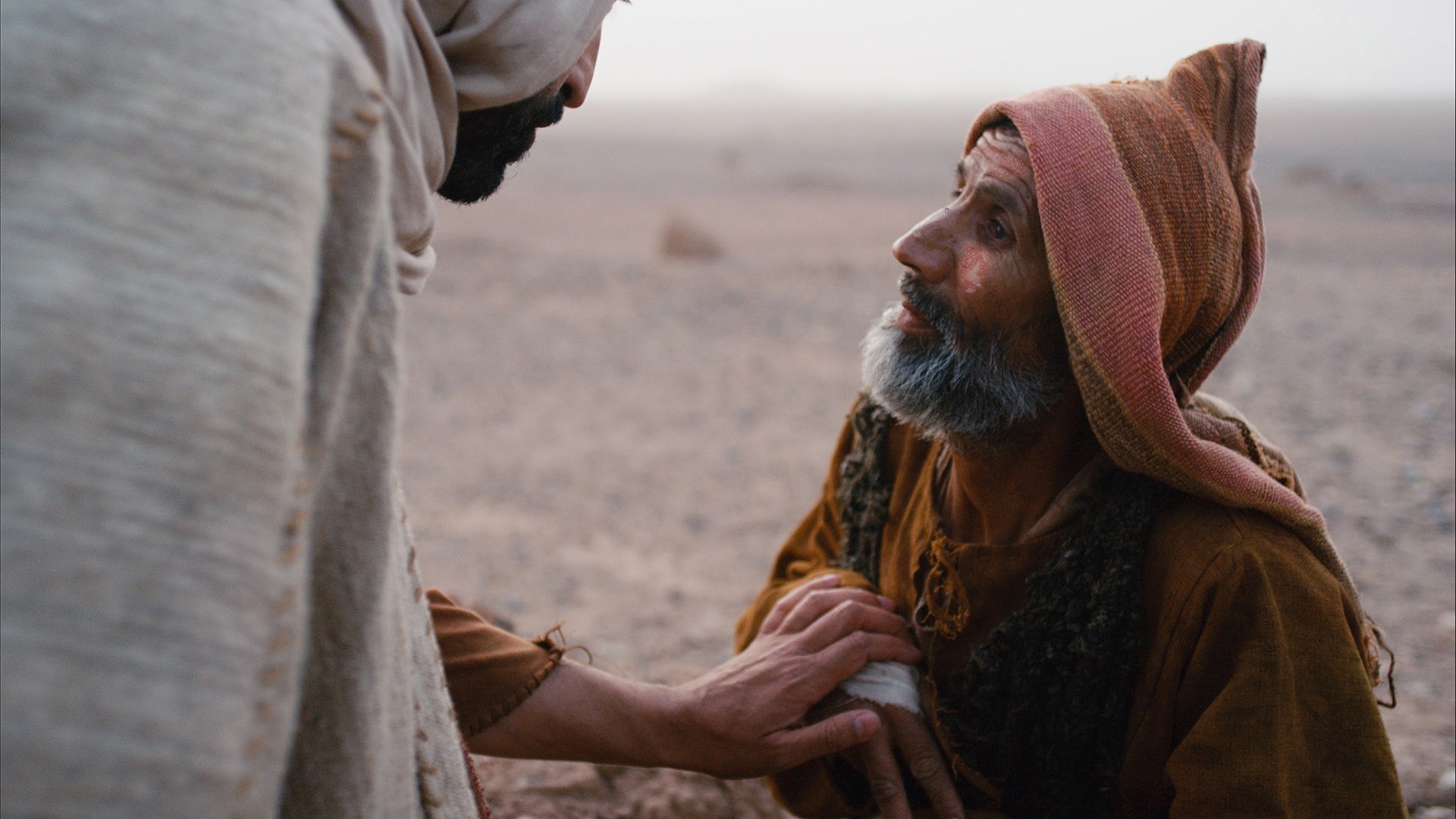
He was supposed to keep a distance of fifty paces and call out to warn any travellers on the road that he was unclean, but he did none of that. Instead, he came right up to Jesus and fell to his knees, uttering the words, “Lord, if you are willing, you can make me clean.”
For a moment, the disciples were not sure how their master was going to react, but Jesus was deeply stirred by what he saw, and what he did next caught all of them by surprise.
He reached out and placed his hand on the man before him. “I am willing. Be clean!”
At that very instant, the skin disease that had plagued the man vanished. He was healed.
Jesus was quick to dismiss the man with these instructions;
“Don’t tell anyone about this. Instead, go to the priest and let him examine you. Take along the offering required in the law of Moses for those who have been healed of leprosy. This will be a public testimony that you have been cleansed.”
The man, unable to contain his joy at being made well, told anyone who would listen what had happened to him. The news spread throughout the region like wild fire and it became harder and harder for Jesus to enter into any village, on account of the vast number of people who were now seeking him out.
Story compiled from Matthew 8:2-4, Mark 1:40-45, Luke 5:12-16
A couple of observations:
Let’s look more closely at what is going on in this interaction with the leper.
Matt 8:2—“Lord, if you are willing, you can make me clean.”
In the Bible, leprosy was a broad term that covered many types of skin disease, and even though we don’t know exactly what form of skin disease this man had, we do know what the consequences of having it were. According to the Law given to Moses, anyone with a skin disease had to isolate themselves from the wider community.
Forced to live in special camps beyond the city walls, lepers were not allowed to come within 2 metres of another person, and if the wind was blowing, they were not allowed within 50 paces of another person. They had to warn anyone who might approach them by calling out ‘unclean’ and they had to cover their mouth.
If you read through Numbers Ch5 and Leviticus Ch’s 13-14, you will begin to get a picture of what life for someone with leprosy might be like; If you discovered a skin infection, you had to isolate outside the city walls for seven days. If you were lucky, your condition would clear up within seven days and you could present yourself to the priest, offer the prescribed sacrifice, and be declared clean. You would be good to go.
But if your condition continued, or worsened, you faced the possibility of a lifetime of isolation—and not just social isolation.
As someone declared unclean, you were not allowed to enter the temple or synagogue. You were effectively cut off from any aspect of worship.
So it’s interesting to take note of what the leper is actually asking Jesus to do for him, “Lord, if you are willing, you can make me clean.”
To be made clean means more than just being healed. In fact, the word translated as clean has a four fold meaning—a meaning not lost on Matthew’s audience— and Matthew uses it intentionally in this way in this passage.
As well as physical healing, it has the idea of ceremonial purification, the return to fellowship with people, and the freedom to worship in the temple. In other words, wholeness.
But what catches my attention in this story is how the leper asks… “Lord, if you are willing…”
Don’t make the mistake of thinking this is a passive, half-hearted request. “Hey Jesus, Iv’e got this little problem I’m hoping you can help me with. But if not, that’s OK, I’ll just continue to deal with it on my own. Sorry to bother you.”
Matthew says he knelt before Jesus and asked—Mark says he knelt before Jesus and begged—Luke says he fell facedown and begged.
Either way, the intention is clear. Here is a man who knows he can’t help himself. In fact, he knows that in all likelihood, no-one can help him. So why has he come to Jesus?
What has he seen? What has he heard? Who does he think this Jesus is?
That question is exactly why Matthew places this story where it is, directly after the Sermon on the Mount. Matthew wants to show his audience—and us—that the Kingdom of God is not only near, it has arrived.
Through Jesus, the wholeness of Heaven is touching the brokenness of Earth.
Whether by faith or sheer desperation, or both, this man with a serious skin disease has come to Jesus because he believes, with all his heart, that Jesus can restore him to wholeness.
“Lord, if you are willing, you can make me clean.”
To Matthew’s Jewish readers, this is a powerful statement of intent—a reminder of who Jesus really is—because in their experience, tradition, and belief, only God can heal someone of leprosy. In fact, it was placed in the same category of miracles as raising someone from the dead.
But what Jesus actually did goes much further than just bringing wholeness and restoration to a desperate man. By reaching out and touching him, Jesus demonstrates not only his authority and his power, but his love.
In a society turned upside down by war, escalating crime, and splintering religious factions, many Jewish people—whether traditional or converts to Christianity—would have felt isolated.
Its important to remember that Matthew is writing to a predominantly Jewish Christian audience, a community that was encountering new issues during a time of both social and political reconstruction after the first revolt against Roman rule (around 66AD) and the subsequent war that lasted 4 or so years.
During that time, vast numbers of Jewish people fled Jerusalem and Judaea and moved north, settling in Galilee and the surrounding areas. By the end of that 4 year war, the city of Jerusalem had been severely damaged, crime was rampant, and the temple itself had been destroyed.
The loss of the temple created a religious vacuum. People felt as though God had abandoned them—or that He was punishing them—and everyone was asking the question, “What does it even look like to be Jewish now?”
Interestingly, it was exactly during this period of chaos that the Pharisees would rise to become the new dominant force in the reconstruction of Jewish life and religious practice. This was the new age of the Rabbi. As the teachers of Jewish tradition and the interpreters of Torah and Law, it was this group who would come into conflict with the growing Jewish Christian community.
It’s into this social and political turmoil that Matthew delivers his Gospel. He is writing to persuade them—to remind them—that Jesus of Nazareth was in fact the promised, and long-awaited for, Messiah.
Through this story—and the ones Matthew places next to it—we see a tangible demonstration of God’s love for those who are isolated, cut off, and living on blurred lines.
So what are the implications for us as the church? What might this story be telling us about our role in the current age? An age of increasing isolation, an age of polarising ideologies, the new age of the meta-verse.
Personally, I find myself left standing with this question…. Am I willing?
Am I willing to actively participate in what God is wanting to do in this age—the period of history between Jesus’ ascension and his return.
Am I willing to proactively love those around me in a tangible way that demonstrates God’s love for them?
Am I willing to reach out and touch—to embrace, to hold, to walk alongside—those in our community who are isolated.
Prayer
Jesus, move in power across our world. Stretch out your hand to heal, restore, and reveal your glory.
Image credit: Courtesy of Lumo Project Films