Category: Prayer

  • Faith Brings Restoration

    Faith Brings Restoration

    After crossing back over the lake to his home town, Jesus and the disciples had no sooner stepped off their boat when they found themselves surrounded by a growing crowd. It was as if they were expecting Him. One man in particular was very eager to speak with Jesus. His name was Jairus and he was a leader in the local synagogue. He approached Jesus and fell at his feet, pleading with him to come to his house. His only child, a little girl of twelve, was very close to death. “Come and lay your hands on her so she will get well and live.”

    Jesus agreed to go with Jairus, so they set off through the crowd towards his house but it was slow going, because so many people were pressing around them. All of a sudden, Jesus stopped.  Everyone stopped. “Who touched me?” Jesus asked. 

    Unbeknown to everyone, there was a woman in the crowd who had been following with all the others. She had a medical condition that caused her to bleed continually. She had suffered with this condition for 12 years and spent all her money on doctors and healers, trying to find a cure, but it had only gotten worse. She believed that if she could just touch the edge of this teachers robe, she would be healed. 

    Those closest to Jesus commented, “Master, look at the crowd. How can you ask ‘Who touched me?’”

    But Jesus insisted. “Someone did touch me. I felt healing power flow out from me.” 

    Realising that she had nowhere to hide, the woman stepped forward and fell and Jesus’ feet, blurting out her whole story in front of everyone. When she had finished speaking, Jesus responded, “Daughter, your faith has made you well. Go in peace. Your suffering is over.”

    As he was saying this, some people pushed through the crowd bringing news to Jairus. “Your daughter is dead. You need not bother the teacher any more.” Jesus heard the report and immediately spoke to Jairus, “Don’t be afraid. Only believe. Your daughter will be made well.”

    Jesus went straight to Jairus’ house, taking only Peter, James and John with him. When they got there, they could hear the sounds of wailing and crying. Jesus went inside and confronted the mourners, “Why are you making such a commotion? Stop crying. The girl is not dead, she is only asleep!” Those who had gathered to mourn laughed in his face, so he ordered them to leave the house. After they had gone, Jesus went into the room where the little girl was lying. Peter, James and John went with him, as did the girls mother and father. 

    Jesus held the girls hand in his and spoke to her, “Little girl, get up.”

    Immediately, the girl got up and walked around the room. Her parents, along with the three disciples, were utterly floored by what they saw. Jesus told them to give her something to eat and instructed them to tell no one about what they had seen. 


    Prayer

    Lord Jesus, help me to filter out the noise of all the doubts in my mind. Reach out into the quiet, broken, or lifeless places of my life, take my hand, and speak Your word of resurrection and awakening. Amen.


    Image credit:Image credit: Courtesy of Lumo Project Films

  • A Kingdom Table In A Transactional World

    A Kingdom Table In A Transactional World

    Leading Like Jesus: 5 Ways to Build a Kingdom Table in a Transactional World

    Imagine throwing a major celebration, inviting all the local leaders and influencers, and having every single one of them text you at the last minute with a flimsy excuse.

    “I just bought some property and need to look at it.”

    “I have some new equipment to test out.”

    “I just got married, so I can’t make it.”

    That is exactly the scenario Jesus describes in Luke 14. One of the dinner guests—probably in an attempt to lighten the mood or make himself sound knowledgeable—interjects with a pious-sounding exclamation: “Blessed is the one who will eat at the feast in the kingdom of God.” 

    By saying this, he was actually reflecting a common Jewish belief of the time: that when God’s Messianic kingdom arrived, all devout Israelites (especially religious leaders and respectable people) would automatically share in a glorious, celebratory feast.

    But Jesus, instead of agreeing with the guest’s comment, uses the statement as a launchpad to tell a parable, the point of which was to warn that many people who assume they have a reserved seat at God’s feast will actually miss out because they let worldly distractions (land, business, or family obligations) take priority.

    Once again, we see the up-side-down kingdom at work. The people who originally expected to be at the table rejected the invitation, so the master opened the feast to the poor, crippled, blind, and marginalised from the streets. The principal—the kingdom of God is available to anyone who will accept the invitation to come in. 

    For Christian leaders navigating today’s competitive, status-driven culture, this parable is a radical leadership wake-up call. Here are five ways Jesus challenges us to lead differently.

    1. Break Out of Your Echo Chamber

    Modern culture encourages us to stay in comfortable, curated bubbles. Whether professionally or socially, we naturally gravitate toward people who share our background, job title, political or theological views.

    The Leadership Shift: Jesus was all about breaking boundaries, not drawing them. Following His example means deliberately reaching across cultural, social, or demographic divides. Your leadership team should look like the Kingdom: diverse, unexpected, and unified by grace.

    2. Choose Radical Hospitality Over Networking

    Conventional ancient hospitality was deeply transactional and reciprocal—you hosted people of equal or higher social standing to gain honour, alliances, or as a return invitation. Our culture is also transactional. People constantly ask, “If I give you my time or resources, what do I get in return?” 

    Jesus subverts this by demanding unconditional generosity toward those who have nothing to offer in return. 

    The Leadership Shift: Lead with a mindset of generosity, not return on investment (ROI). Invest in your team members, mentees, and even your neighbours without expecting anything back. True Christian leadership means giving your time, availability, and mentorship to people who cannot advance your career or repay the favour.

    3. Drop the “Badge of Busyness”

    Today, being stressed and totally booked solid is often worn as a badge of honour. We use it to signal that we are important and successful. But the excuses made by the original banquet guests—business, property, and family obligations—are the exact same things we use to look important today.

    The Leadership Shift: Do not let the pursuit of cultural success cause you to miss the people right in front of you. If you are too busy checking your “fields” (KPIs, metrics, profits) or your “oxen” (tools, technology, assets) to notice someone who is hurting or needs guidance, then the sad reality is that the culture has already captured your focus. We must always prioritise people over production, profit, and performance. 

    4. Practice Intentional Pursuit, Not Just “Open Doors”

    A lot of organisations (including churches) practice “performative inclusion”—they say the right words or aim to hit a visible inclusiveness quota, but leave it at that. However, the host in the parable recognised that people on the margins wouldn’t feel welcome by default unless someone actively went out to assure them they belonged.

    The Leadership Shift: An open-door policy isn’t enough. You have to actively go out into the “highways and hedges” of your community. Seek out the quietest voice in the room, the person struggling with burnout, or the individual holding a minority perspective. Tell them directly: “Your voice is required for us to succeed.” And in case you are wondering, those who find themselves in a minority, those who face social exclusion, those who don’t feel like they have a voice—they know only too well if your organisation is simply paying lip service to the idea of inclusiveness—because the proof is never in the words you use, its in what you actually do. 

    5. Pivot Through Rejection

    In a world obsessed with immediate approval and upward-trending metrics, rejection can feel fatal. When the host in the parable faced public embarrassment from the town’s elite, he didn’t give up, compromise his standards, or sink into despair. He simply doubled down on his original vision.

    The Leadership Shift: Anchor your identity in Christ, not in corporate approval or cultural validation. When your values are rejected or your plans face setbacks, make a holy pivot. If traditional avenues close, look for where the Holy Spirit is moving among the unexpected and the humble, and put your energy there.

    The Big Picture

    The Kingdom of God grows when we break down silos, not when we build them. God’s table is wide open to anyone willing to simply accept the invitation to come in. As a leader, the question isn’t how big is your table—it’s who you are inviting to sit next to you.


    Prayer

    Jesus, teach me to remain in your love today. May your joy flow through me until it quietly overflows into every conversation, every interruption and every ordinary moment. Amen.


    Image credit: Romain Gal on Unsplash

  • Rising Like Incense

    Rising Like Incense

    A Reflection on Psalm 141:2

    There is a sacred shift that happens when the sun begins to dip below the horizon. The noise of the day starts to fade, leaving us with a choice: do we carry the weight of the last twelve hours into the night, or do we lay it down?

    In the ancient world, the transition into evening was marked by rituals—the lighting of lamps, the burning of sweet incense, and the evening sacrifice. In Psalm 141:2, the psalmist captures this beautifully:

    “Accept my prayer as incense offered to you, and my upraised hands as an evening offering.”

    When our words feel small and our bodies feel tired, this verse reminds us that our simplest prayers are powerful, beautiful, and deeply personal.

    Finding Your Quiet Space Tonight

    Prayer doesn’t always require a long list of requests. Sometimes, it is simply about posture.

    Like incense, our thoughts can drift upward without a rigid structure. Like an evening offering, lifting our hands—or simply opening our palms—is a physical way of saying, “I am letting go of today, and I am trusting You with tomorrow.”

    As you wind down before bed tonight, consider these three thoughts:

    • What are the “fragments of the day” that you might need to let rise and drift away into God’s hands?
    • In what areas do you need to practice total surrender (opening your hands) right now?
    • Can you take three deep breaths, simply resting in the fragrance of grace, without asking for anything at all?

    Prayer

    Father, as I rest in your presence now, I imagine my prayers rising like incense,
    a ribbon of smoke curling upward,
    carrying the many fragments of my day into Your presence.

    Lord Jesus, see my empty, open hands—I offer them to You now as my evening sacrifice— a gesture of surrender at the threshold of the coming night.

    Holy Spirit, help me now to let go of today’s pressing demands, and rest in the fragrance of Your grace—and simply breathe.

    Amen.


    Image credit: AI generated by Matt Fricker

  • Suppression and Release

    Suppression and Release

    There is an interesting story recorded in Mark 1:23–26 and Luke 4:33–35, about Jesus suppressing the news about who He really was. 


    The sun had barely set when there was a knock on the door of Andrew and Peter’s home. When Peter opened it, he was confronted by a large crowd of people. It seemed as if the whole town was gathered, eager to see the teacher. Word had spread like wild fire about what had happened at the synagogue earlier that day. 

    Jesus had been there, teaching with an authority that amazed all who heard him, but he had caused quite a stir when he cast a demon out of a man. As Jesus was speaking, the demon manifested itself and demanded to know what Jesus wanted. 

    “What do you want with us, Jesus of Nazareth? Have you come to destroy us? I know who you are—the Holy One of God!”

    Jesus responded sharply. “Silence! Come out of this man!”

    At once the demon violently left the man and retreated, shrieking as it went. 

    All who witnessed the event were amazed. 

    So now, the people of Capernaum were at the home of Andrew and Peter with their sick family members and friends. Jesus met with them late into the night and many people were healed. 

    They also brought those who were spiritually troubled and Jesus drove many demons away. But he would not let the demons speak, on account of them knowing who he was. 


    There are a few reasons Jesus doesn’t want the full revelation of who He really is to be public knowledge, but first and foremost is the fact that he understood that His Father was working to a plan—a plan that could not be rushed. 

    I wonder, how often do we try to push God’s agenda forward because it suits our schedule? 


    Prayer

    Father, guide me in the paths of wisdom when it comes to the plans you have for me. 

    Jesus, continue to shape me into your likeness, my thoughts, my words, my actions.

    Holy Spirit, thank you for your ever present comfort, guidance and leading. Amen.


    Image Credit: Courtesy of Lumo Project Films

  • Reframing Reality

    Reframing Reality

    All eyes were fixed on the hole in the side of the hill. Some in the crowd that had gathered were murmuring and whispering. Most stood silent, the words of Jesus still echoing in their minds. 

    “LAZARUS, COME OUT!”

    The air was thick with anticipation. 

    And then he appeared, still wrapped in his burial shroud. Jesus instructed some of those standing near by, “Unwrap him, and let him go!”

    Many of the people who had come out with Mary and Martha to mourn with them, when they saw Lazarus alive, believed who Jesus was. But some were troubled, and went to the Pharisees to tell them what Jesus had done. 

    Imagine, if you can, spending your whole life putting your faith and hope in the teachings and traditions of your trusted elders and leaders, only to witness for yourself something so profound that it rocks your whole belief system. Would you be suspicious? Confused and thrown off balance? Would you even be able to accept what you had just seen with your own eyes? You might even feel angry. 

    Who is this man? And how is he able to do that which only God can do? This is a very important question to ponder—perhaps the most important question of all. 

    In that moment—when the realisation of what you have experienced hits you—I wonder if you might allow the gift that is the reframing of your reality to reform and re-story your understanding of who Jesus really is. 


    Prayer: Father, in the middle of all that’s going on in my life — the grief, the busyness, the fear, the questions — I choose to run to you today. I know you have something to show me and that there’s more of you to know. Expand the borders of my heart and fill in the black and white spaces of my theology with the beautiful colours of new life.

    Prayer excerpt from the Lectio 365 app, courtesy of 24-7 Prayer.


    Image credit: Courtesy of Lumo Project Films

  • Crumbs From The Table

    Crumbs From The Table

    Story from Matthew 15 and Mark 7


    The number of people gathering outside the modest villa on the coast was growing by the minute. 

    People from all over Tyre and Sidon had heard that a Jewish Rabbi who had healing powers had snuck into town. In the midst of all the noise and commotion, a Greek woman was making her way through the crowd. Suddenly, there he was. 

    She threw herself onto the floor at his feet, not daring to look at his face. For a moment time stood still. She could see his sandals and his feet, and the edge of his robe was just centimetres from her trembling fingers. The room fell silent as the dust settled. This was her moment, the one she had been waiting for since she had first heard about him. 

    The words barley passed over her lips, “Please Lord, my daughter has an unclean spirit in her. Will you come and drive it away. I beg of you.” 

    Still looking at the healers feet, she waited to hear his reply. He didn’t answer her. The disciples urged Jesus to send her away.

    Finally he spoke, “I must feed the children first-my own family, the Jews. It wouldn’t be right to take the children’s bread and throw it to the dogs.”

    His words were sharp and to the point and it was clear to everyone in the room that she had made a big mistake coming here. 

    But the woman slowly got to her knees and looked at the rabbi. His face was kind and when he looked at her, she felt as though he could see into her soul. She could see that he was different. There was something about this man that caused her heart to fill with hope. But he had denied her request. 

    And so, mustering all her courage, she replied, “Yes, Lord, but even the dogs under the table get to  eat the children’s crumbs.”

    You could almost hear the people in the room draw a collective breath and for a moment, the woman wondered what he might say next. She didn’t have to wait long.

    A slight smile spread across the rabbi’s face as he looked down at the woman kneeling before him, “You have spoken wisely. Return to your home. Your daughter is free of the spirit that troubled her.”

    The woman returned to her home to find her daughter laying on her bed, totally well and happy. Jesus had restored her body, mind and spirit and she was whole once again. The woman had her little girl back. 


    Prayer
    Father, thank you that your mercy is so vast, and your power so great, that even the smallest crumb of your grace is more than enough to heal our brokenness, cast out our fears, and renew our lives.

  • Out Of Isolation

    Out Of Isolation

    This is a story about a man who knew what isolation was all about. Forced to quarantine so he didn’t contaminate others, he lived his life on the edges of society, cut off from his family and his community. He wandered the dusty roads between the towns and villages, spending his days scrounging for food and water, begging on the mercy of others, and longing for a miracle. As each day passed, he slipped further and further into despair and  hopelessness.

    The story begins in Capernaum, a small fishing village located on the northern shore of the Sea of Galilee. An amazing thing had just taken place in the home of Simon and Andrew, who were brothers. Simon’s mother-in-law had been laid up in bed with a fever, and when Jesus heard about it, he went to her bedside, took her by the hand, and healed her. News spread quickly, because by night fall, the whole town has gathered outside the door. 

    That night, Jesus healed many who were sick, and he drove out many demons.

    Early the next morning, Jesus went out to find a quiet place to pray. It wasn’t long before Simon and some others went looking for him. In fact, there was a large crowd of people also looking for him, so Jesus said to Simon and those with him, “Let’s go to all the neighbouring villages, so that I might preach there also. After all, this is why I came. This is what I was sent for.” 

    So that’s exactly what they did. Jesus went from village to village throughout the region of Galilee, preaching in the synagogues, healing the sick, and driving out demons. 

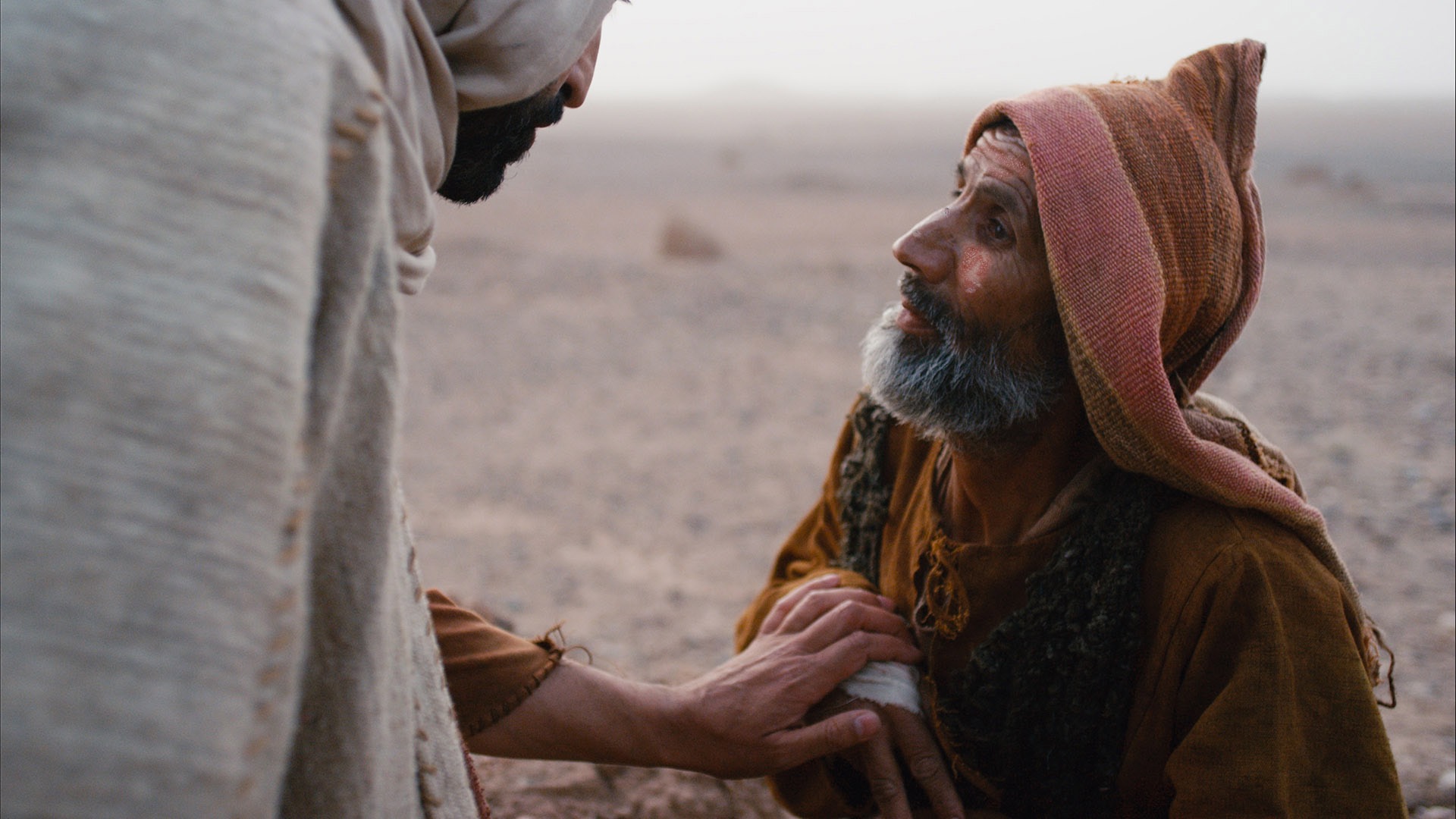
    Then one day, they had an unexpected encounter. Up ahead on the road, a lonely figure appeared. At first it was difficult to tell who it was through the haze, but as they drew closer, they could see that it was a man. He was dressed in ragged clothes and had scruffy, unkempt hair. Was he a traveller, a beggar, a bandit? Was he alone? 

    The disciples were cautious—hesitant to get too close—but the man kept coming towards them. Their worst fears were realised when they saw his skin. He was a leper!

    He was supposed to keep a distance of fifty paces and call out to warn any travellers on the road that he was unclean, but he did none of that. Instead, he came right up to Jesus and fell to his knees, uttering the words, “Lord, if you are willing, you can make me clean.”

    For a moment, the disciples were not sure how their master was going to react, but Jesus was deeply stirred by what he saw, and what he did next caught all of them by surprise. 

    He reached out and placed his hand on the man before him. “I am willing. Be clean!”

    At that very instant, the skin disease that had plagued the man vanished. He was healed. 

    Jesus was quick to dismiss the man with these instructions;

    “Don’t tell anyone about this. Instead, go to the priest and let him examine you. Take along the offering required in the law of Moses for those who have been healed of leprosy. This will be a public testimony that you have been cleansed.”

    The man, unable to contain his joy at being made well, told anyone who would listen what had happened to him. The news spread throughout the region like wild fire and it became harder and harder for Jesus to enter into any village, on account of the vast number of people who were now seeking him out.  

    Story compiled from Matthew 8:2-4, Mark 1:40-45, Luke 5:12-16


    A couple of observations:

    Let’s look more closely at what is going on in this interaction with the leper. 

    Matt 8:2—“Lord, if you are willing, you can make me clean.”

    In the Bible, leprosy was a broad term that covered many types of skin disease, and even though we don’t know exactly what form of skin disease this man had, we do know what the consequences of having it were. According to the Law given to Moses, anyone with a skin disease had to isolate themselves from the wider community. 

    Forced to live in special camps beyond the city walls, lepers were not allowed to come within 2 metres of another person, and if the wind was blowing, they were not allowed within 50 paces of another person. They had to warn anyone who might approach them by calling out ‘unclean’ and they had to cover their mouth. 

    If you read through Numbers Ch5 and Leviticus Ch’s 13-14, you will begin to get a picture of what life for someone with leprosy might be like; If you discovered a skin infection, you had to isolate outside the city walls for seven days. If you were lucky, your condition would clear up within seven days and you could present yourself to the priest, offer the prescribed sacrifice, and be declared clean. You would be good to go.

    But if your condition continued, or worsened, you faced the possibility of a lifetime of isolation—and not just social isolation. 

    As someone declared unclean, you were not allowed to enter the temple or synagogue. You were effectively cut off from any aspect of worship. 

    So it’s interesting to take note of what the leper is actually asking Jesus to do for him, “Lord, if you are willing, you can make me clean.” 

    To be made clean means more than just being healed. In fact, the word translated as clean has a four fold meaning—a meaning not lost on Matthew’s audience— and Matthew uses it intentionally in this way in this passage. 

    As well as physical healing, it has the idea of ceremonial purification, the return to fellowship with people, and the freedom to worship in the temple. In other words, wholeness. 

    But what catches my attention in this story is how the leper asks… “Lord, if you are willing…”

    Don’t make the mistake of thinking this is a passive, half-hearted request. “Hey Jesus, Iv’e got this little problem I’m hoping you can help me with. But if not, that’s OK, I’ll just continue to deal with it on my own. Sorry to bother you.”

    Matthew says he knelt before Jesus and asked—Mark says he knelt before Jesus and begged—Luke says he fell facedown and begged.  

    Either way, the intention is clear. Here is a man who knows he can’t help himself. In fact, he knows that in all likelihood, no-one can help him.  So why has he come to Jesus? 

    What has he seen? What has he heard? Who does he think this Jesus is?

    That question is exactly why Matthew places this story where it is, directly after the Sermon on the Mount. Matthew wants to show his audience—and us—that the Kingdom of God is not only near, it has arrived. 

    Through Jesus, the wholeness of Heaven is touching the brokenness of Earth.

    Whether by faith or sheer desperation, or both, this man with a serious skin disease has come to Jesus because he believes, with all his heart, that Jesus can restore him to wholeness.  

    “Lord, if you are willing, you can make me clean.” 

    To Matthew’s Jewish readers, this is a powerful statement of intent—a reminder of who Jesus really is—because in their experience, tradition, and belief, only God can heal someone of leprosy. In fact, it was placed in the same category of miracles as raising someone from the dead. 

    But what Jesus actually did goes much further than just bringing wholeness and restoration to a desperate man. By reaching out and touching him, Jesus demonstrates not only his authority and his power, but his love. 

    In a society turned upside down by war, escalating crime, and splintering religious factions, many Jewish people—whether traditional or converts to Christianity—would have felt isolated. 

    Its important to remember that Matthew is writing to a predominantly Jewish Christian audience, a community that was encountering new issues during a time of both social and political reconstruction after the first revolt against Roman rule (around 66AD) and the subsequent war that lasted 4 or so years.

    During that time, vast numbers of Jewish people fled Jerusalem and Judaea and moved north, settling in Galilee and the surrounding areas. By the end of that 4 year war, the city of Jerusalem had been severely damaged, crime was rampant, and the temple itself had been destroyed.

    The loss of the temple created a religious vacuum. People felt as though God had abandoned them—or that He was punishing them—and everyone was asking the question, “What does it even look like to be Jewish now?”

    Interestingly, it was exactly during this period of chaos that the Pharisees would rise to become the new dominant force in the reconstruction of Jewish life and religious practice. This was the new age of the Rabbi. As the teachers of Jewish tradition and the interpreters of Torah and Law, it was this group who would come into conflict with the growing Jewish Christian community. 

    It’s into this social and political turmoil that Matthew delivers his Gospel. He is writing to persuade them—to remind them—that Jesus of Nazareth was in fact the promised, and long-awaited for, Messiah.

    Through this story—and the ones Matthew places next to it—we see a tangible demonstration of God’s love for those who are isolated, cut off, and living on blurred lines. 

    So what are the implications for us as the church? What might this story be telling us about our role in the current age? An age of increasing isolation, an age of polarising ideologies, the new age of the meta-verse. 

    Personally, I find myself left standing with this question…. Am I willing? 

    Am I willing to actively participate in what God is wanting to do in this age—the period of history between Jesus’ ascension and his return. 

    Am I willing to proactively love those around me in a tangible way that demonstrates God’s love for them?

    Am I willing to reach out and touch—to embrace, to hold, to walk alongside—those in our community who are isolated. 


    Prayer
    Jesus, move in power across our world. Stretch out your hand to heal, restore, and reveal your glory.

    Image credit: Courtesy of Lumo Project Films

  • Terrified Of Jesus

    Terrified Of Jesus

    Every time I come across the story of Jesus calming the storm, I find myself wondering about the disciples’ response to what Jesus does. 

    In particular, I have been confounded by the shift from fear to terror. 

    When Jesus woke up, he rebuked the wind and said to the waves, “Silence! Be still!” Suddenly the wind stopped, and there was a great calm. Then he asked them, “Why are you afraid? Do you still have no faith?” The disciples were absolutely terrified. “Who is this man?” they asked each other. “Even the wind and waves obey him!”
    Mark 4:39-41

    One of the questions we need to ask from this passage is ‘What does this story tell us about Jesus?’

    As I think about this question, I am reminded of the story of when Jesus called the four fisherman. In Luke’s extended version of that event, we have recorded an interesting dialogue between Jesus and Simon Peter. You can read the story here.

    When Simon Peter realised what had happened, he fell to his knees before Jesus and said, “Oh, Lord, please leave me—I’m such a sinful man.” For he was awestruck by the number of fish they had caught, as were the others with him. His partners, James and John, the sons of Zebedee, were also amazed. Jesus replied to Simon, “Don’t be afraid! From now on you’ll be fishing for people! And as soon as they landed, they left everything and followed Jesus.”
    Luke 5:8-10

    It turns out that the Greek word translated as afraid in Luke 5:10 is the same as the word translated as terrified in Mark 4:41. The word is Phobos and it implies to fear something or someone out of awe and reverence ( ie, the fear of God). 

    This is significant. For Simon Peter, the realisation of who Jesus was in that moment resulted in fear. Why? Well, it turns out that there is a much deeper, historical context to Simon’s response,and it has its origins in Simon’s understanding of the Old Testament stories. 

    You see, Simon fully recognised that this miraculous catch of fish was nothing short of a divine intervention by God. And he was afraid. Why? Because all throughout the history of Israel, whenever someone encountered the power and manifest presence of God, they expected to die. 

    So what was it about who Jesus was that warranted the same response from the disciples in the boat on that stormy night? 

    The answer can be found by looking at the difference between the two fears. 

    In verse 40, Jesus asks them, “Why are you fearful?” The word here is deilos and it means to be afraid, timid or cowedly. The disciples, even though some of them were seasoned fisherman, were afraid that they were going to die in the raging storm. This is a natural human response considering the situation. 

    Now contrast that with terrified in verse 41. To be more exact, the word terrified is actually made up of two greek words, phobos megas, or literally, great or intense fear. 

    The disciples went from being afraid because of the situation they were in, to being overwhelmingly afraid because of what Jesus did. But what exactly did he do that solicited such a strong response? 

    Once again, it turns out that there is a much deeper, historical context that explains the disciples response, and it has its origins in their understanding of the Old Testament.

    You quieted the raging oceans with their pounding waves…
    Psalm 65:7

    You rule the oceans. You subdue their storm-tossed waves.
    Psalm 89:9

    Some went off to sea in ships, plying the trade routes of the world. They, too, observed the Lord’s power in action, his impressive works on the deepest seas. He spoke, and the winds rose, stirring up the waves. Their ships were tossed to the heavens and plunged again to the depths; the sailors cringed in terror. They reeled and staggered like drunkards and were at their wits’ end. 
    “Lord, help!” they cried in their trouble, and he saved them from their distress. He calmed the storm to a whisper and stilled the waves. What a blessing was that stillness as he brought them safely into harbor!
    Psalm 107:23-30

    Like Simon Peter in Luke 5, the disciples in the storm tossed boat fully recognised that this miraculous calming of the wind and of the waves was nothing short of a divine intervention by God.

    In the Old Testament, only God could command the forces of nature. Think about that for a moment. Jesus didn’t pray to his father to intervene on their behalf…the wind and waves were obedient to the power of His command!

    The disciples’ awe inspired fear is understandable and their question is valid…

    “Who is this man?”


    I invite you to pray with me: Lord Jesus, help me to gain a deeper understanding of who you really are.


    Image credit: Matt Fricker Photography

  • Do As I Have Done

    Do As I Have Done

    After washing his disciples feet, Jesus said to them: “Now that I, your Lord and Teacher, have washed your feet, you also should wash one another’s feet. I have set you an example that you should do as I have done for you.”

    Prayer for today…

    Lord, in an age when so much of our culture thrives on outrage and division, and everyone has an opinion, may your Church be an oasis of cleansing grace and kindness.


    Excerpt from todays reflection on Lectio 365

  • Blinding Re-alignment

    Blinding Re-alignment

    Rewritten from a post first published June 2015.


    Sometime between AD 15—20 Saul began his studies of the Hebrew Scriptures in the city of Jerusalem under Rabbi Gamaliel, in one of the the most prominent rabbinical schools of that day, founded by his grandfather, Hillel. Gamaliel was also the president of the Sanhedrin, a position he inherited from his father.

    It was in this environment that Saul received his education in Judaism and became well versed in its dogma and law. Sometime during his educational years, it was instilled in him a fervent hatred for Christ and His followers.  This indoctrination set Saul up to become the perfect agent in the employment of the Sanhedrin against the Christians. In the thirty something years that Saul was in Jerusalem, he would have made many trips throughout the Roman world working to arrest and testify against the followers of Jesus Christ. One such trip was to the city of Damascus, located 130 miles from Jerusalem. Saul was going there with the sole purpose of arresting the followers of Christ.

    Luke (the writer of Acts) tells us that Paul took the initiative of going to the High Priest to ask for authority to go to Damascus to hunt out the Christians there. While on his way to Damascus, Saul was stopped in his tracks by a blinding light. What followed was one of the most dramatic conversions in Christian history. Right there on the road, Saul was confronted by Jesus himself.

    “He fell to the ground and heard a voice saying to him, “Saul! Saul! Why are you persecuting me?”
    “Who are you, lord?” Saul asked.
    And the voice replied, “I am Jesus, the one you are persecuting! Now get up and go into the city, and you will be told what you must do.”
    Acts 9:4-6

    Saul of Tarsus became the apostle Paul, missionary to an unbelieving world and a fine example of faithful service in the face of fierce persecution. Saul’s education, his background as a Pharisee, his Roman citizenship, and his unflagging zeal all contributed to his success as a missionary, but only once those credentials and traits had been subjugated to the lordship of Jesus.


    Pray with me: Lord Jesus, I invite you to re-align any aspect of my life that needs to come under your lordship. 


    Image credit: Pexels